Software & Automation
Parametric Water Tank Configurator
A B2B configure-price-quote suite for modular water tanks — 3D configuration, automated engineering calculation and instant Excel bill of materials.
The business problem
At Meksis Mekanik Sistemler, a manufacturer of modular water storage systems, every quotation was assembled by hand in spreadsheets that had been copied, patched and re-copied for years. Panel counts across three axes, half panels, bolts, gaskets, nozzle positions, material grade and press pattern all feed one another — and all of it was maintained manually. The consequences were commercial, not technical:
- Connection points decided too late. Customers could not see where their inlets and outlets would sit, so positions were agreed verbally and only became concrete after fabrication had already started.
- Errors that reach the shop floor. One stale cell in a copied sheet propagates into the parts list. A wrong panel or bolt count is not a pricing mistake — it is material cut to the wrong size, a tank that will not assemble on site, and rework.
- Knowledge locked in people. The rules for each tank family existed in the heads of a few engineers, not in a system.
Solution: a parametric configurator, not another spreadsheet
I designed and built a suite of applications that treat the tank as a parametric model instead of a document. The user enters length × width × height in panel counts; everything downstream is derived from that single input and stays consistent by construction:
- volume in m³ and litres
- full and half panel counts, and base/roof panel layout
- bolt, nut, gasket and sheet metal quantities
- front, side and top technical drawings plus the flat unfolding
- a priced bill of materials exported straight to Excel and PDF
One workflow, end to end
| Capability | Role in the sales-to-production chain |
|---|---|
| Configuration + engineering calculation | Cylindrical and prismatic tanks in one place, with a live 3D model beside the numbers |
| Panel calculation and technical output | Panel layout, internal bolt distribution, technical views, one-click Excel and PDF export |
| Customer-facing 3D configurator | The buyer builds the tank, places inlets and outlets on it, and submits a technical quotation request |
| Cylindrical tank module | The parametric rules specific to cylindrical bodies |
Each supported tank family carries its own manufacturing rules — GRP, YMD, BMD, İMD, EKO and the corrugated cylindrical types — including constraints such as GRP's 1 m vertical panels stacked to a maximum height of 3 m. The press pattern drawn on a panel in the technical unfolding is generated from the same code as the pattern shown in the 3D view, so the drawing and the model cannot drift apart.
The suite works online and offline. Engineering runs as a native desktop application that keeps working when the network does not — a factory floor is no place to depend on a connection — while the customer-facing configurator is reachable online, so a buyer can specify a tank and send a request without installing anything.
Turning a 3D viewer into a sales instrument
The commercial gap was not calculation — it was imagination. Buyers and mechanical contractors could not picture nozzle placement from a drawing, so they deferred the decision.
The sales configurator closes that gap: the customer places inlets and outlets directly on the 3D tank, and each one is logged with a generated ID. What used to be a verbal agreement becomes a documented specification attached to the quotation request.
Design: four tools that finally look like one product
The applications were written at different times for different users, each with its own visual language. I wrote a shared design token layer and unified them under one interface: a single palette, blue for primary actions, the Meksis red reserved for brand moments, green for inlets and red for outlets.
The constraint was deliberate and strict: only colour, typography and chrome could change. Every calculation engine and line of business logic stayed untouched, so nothing already validated on the shop floor had to be re-validated — a zero-risk redesign.
The hard part
The real challenge was never geometry. The same panel logic has to exist in two places at once — inside the sales configurator and inside the engineering calculation — and the two must agree exactly. A change applied to one and not the other produces a quotation the factory cannot build.
The second challenge was trust. A tool that replaces a spreadsheet inherits its burden of proof, so the applications were rolled out module by module against known jobs, with the existing Excel output kept as the reference until the numbers matched every time.
Outcome
Quoting a modular water tank is now a parametric process rather than a manual one: enter the dimensions, see the tank, get the parts list and the drawings. Sales can show a customer exactly where their connections will sit before anything is cut. Engineering works from numbers that are derived, not retyped. And the manufacturing rules that used to live in a few people's experience now live in the tool.
More projects
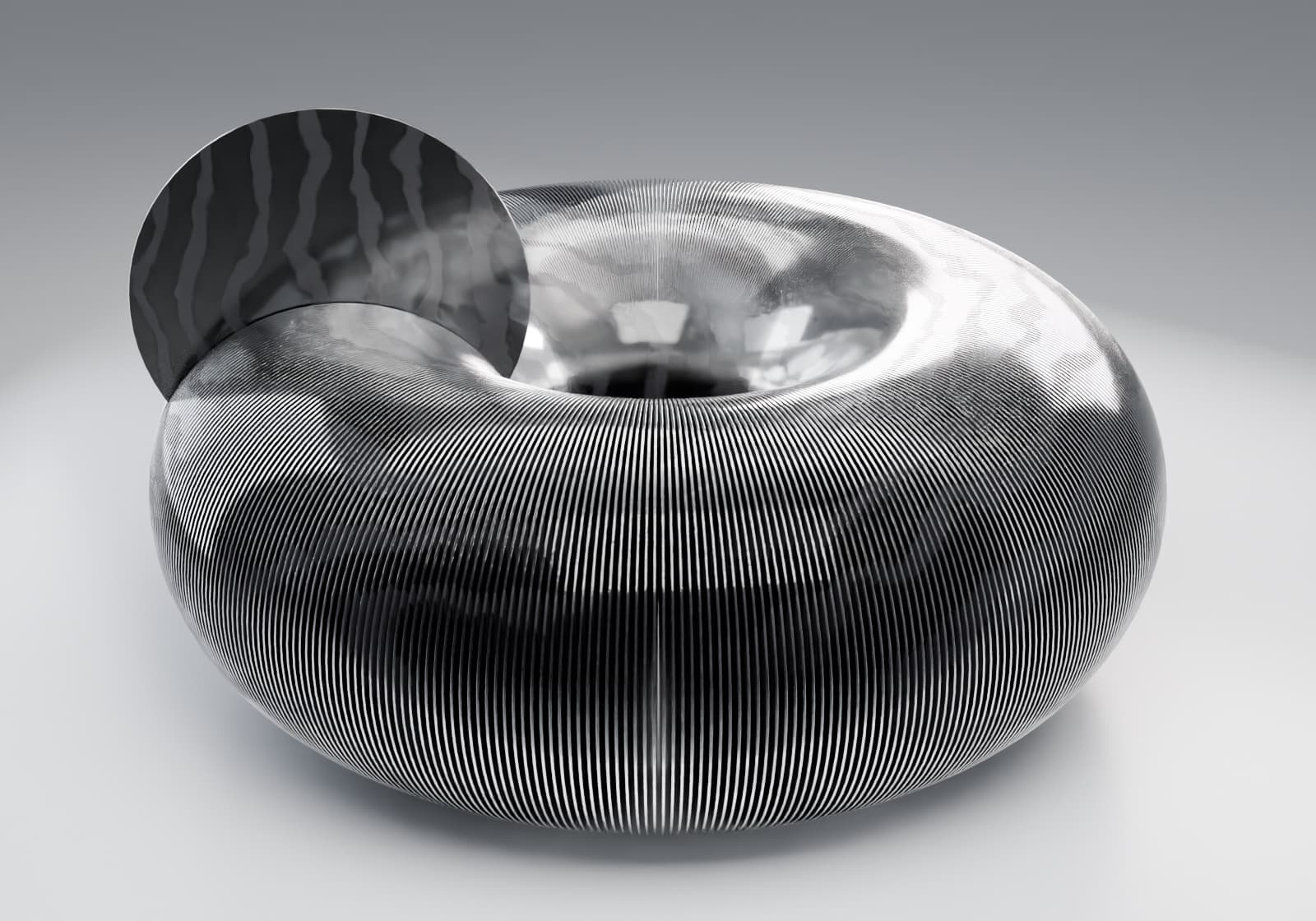
CORCA
A parametric pattern study on ceramic — a torus scaled to the Earth's diameter, cut into pieces where no two are ever alike.
View project
Aerodynamics
Aerodynamic rendering and fast approximations powered by AI-assisted workflows.
View project
Realistic & Abstract Renderings
Realistic or unrealistic — it doesn't matter. I create and render all kinds of product visualizations.
View project